Tuesday, July 04, 2006

Tilism at NCPA, Mumbai: June 23, 2006


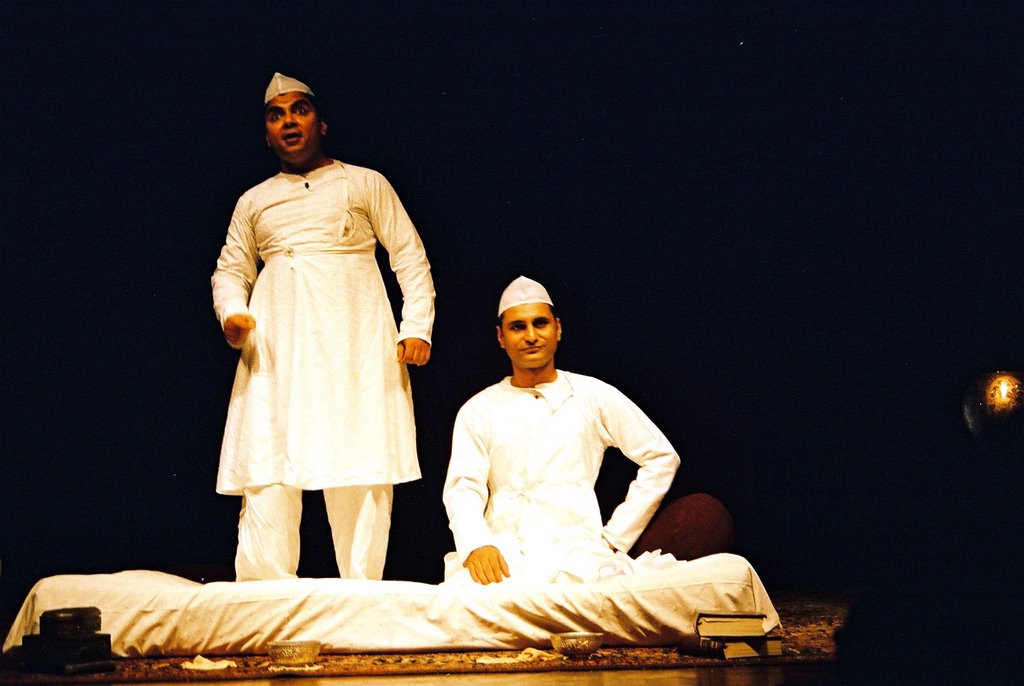
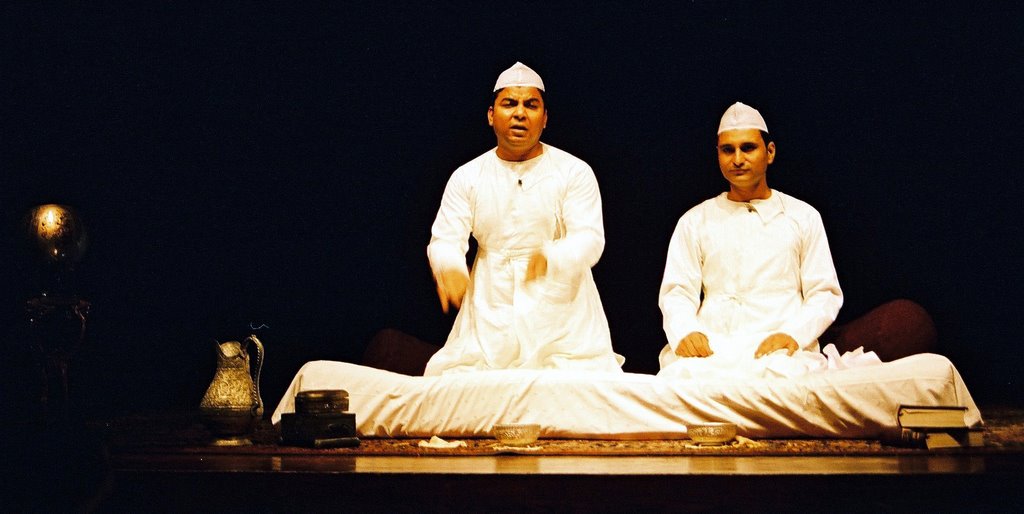
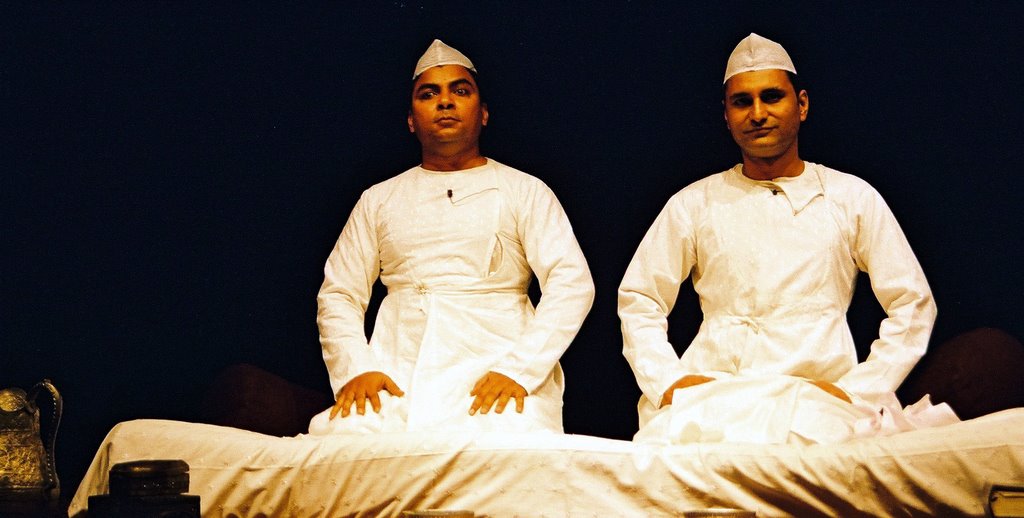
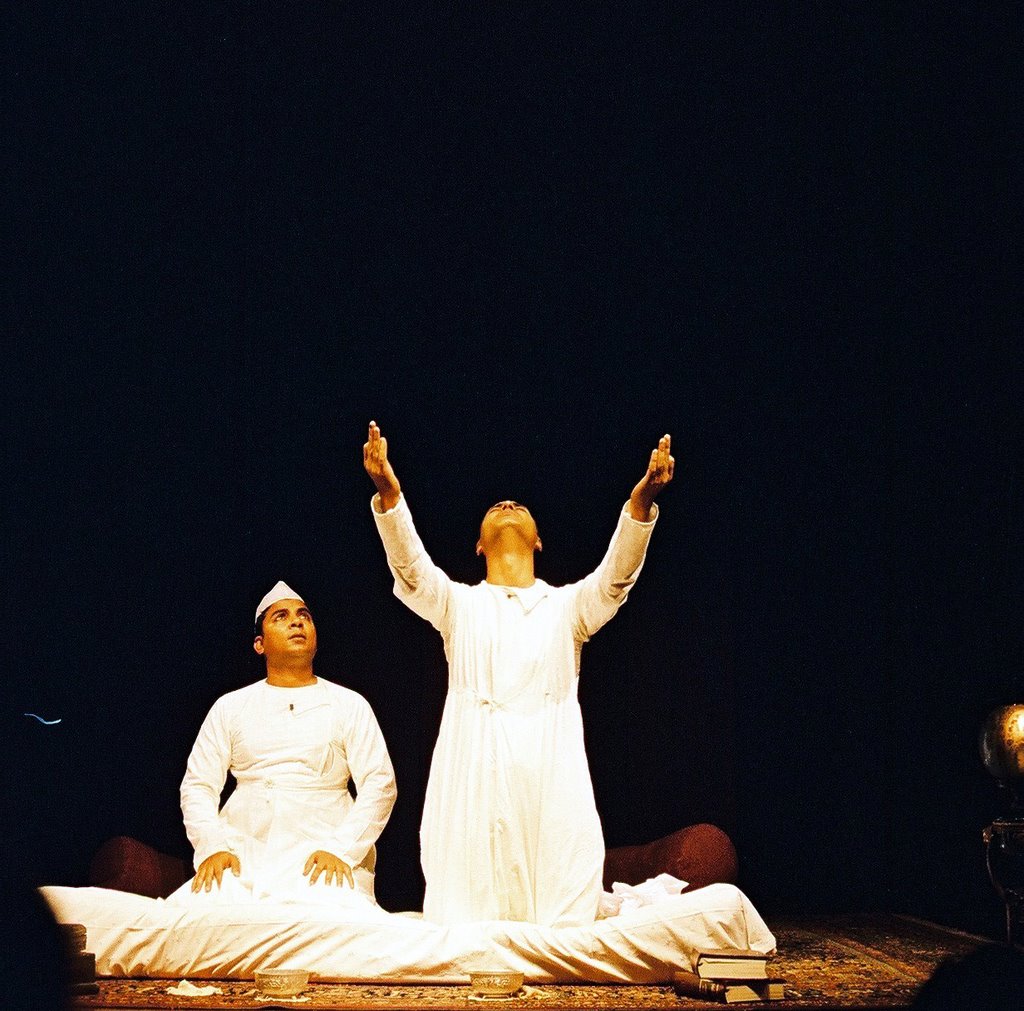
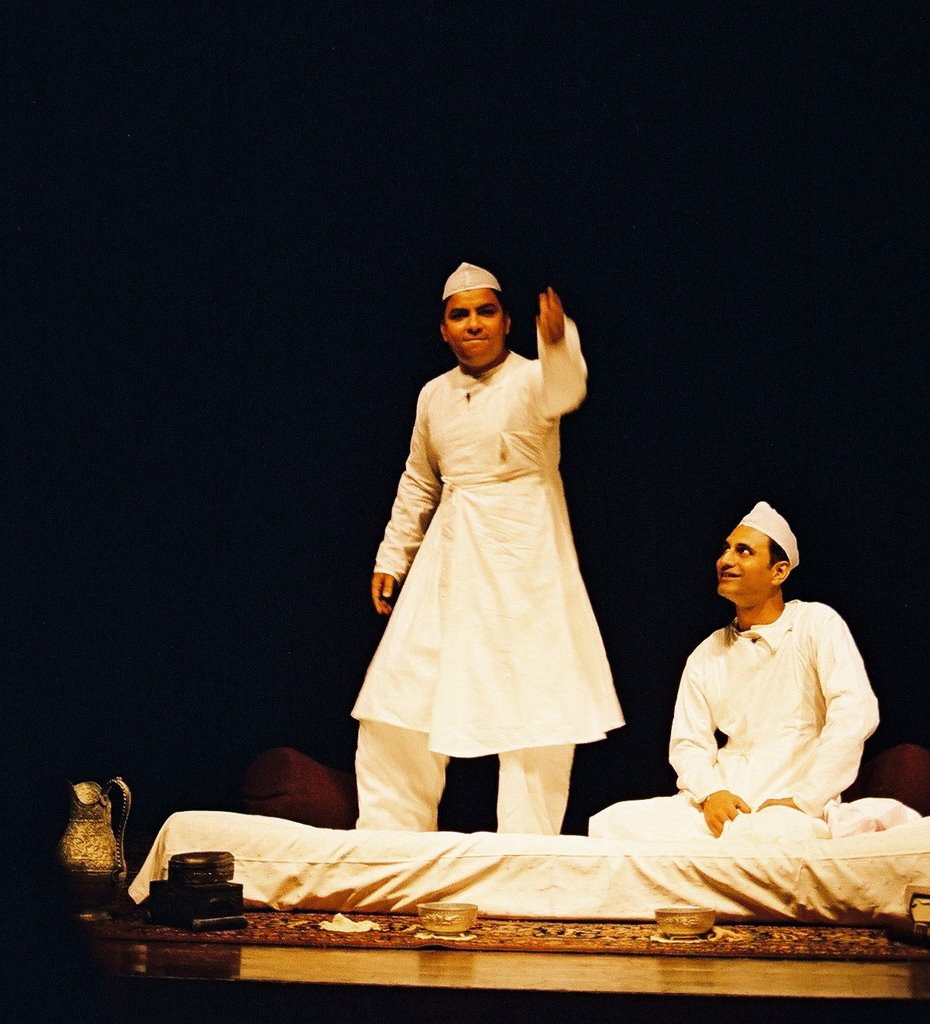
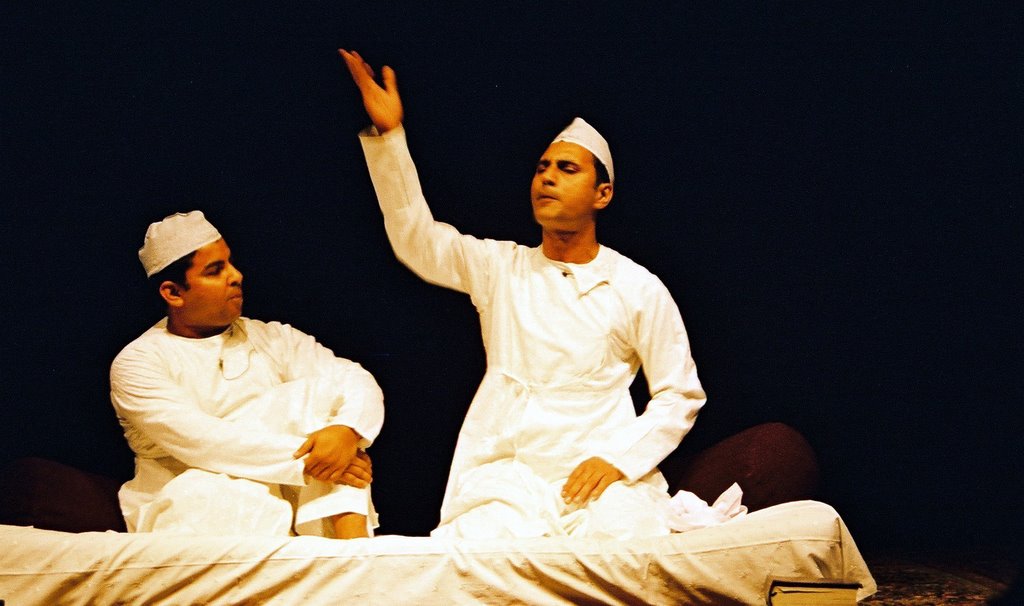
The Dastangos revel in the accolades they get.


Afrasiyaab is baffled after hearing Amar Aiyaar's tales about Laqa.


Ya Allah! Some story this guy Amar Aiyaar is spinning now.


Amar Aiyyaar spins a yarn about Laqa, the false god.


The complaining Kalwaar as Asmaan Shola-khwaar Jaadu hears him out.


A vain Asmaan Shola-khwaar Jaadu.


Amar Aiyyaar in a state of self pity.


The indignant dhobi accuses a fellow onlooker.


Afrasiyaab surveys his kingdom from his magical flying takht.
Photographs: Courtsey Abhinandita Mathur

Saturday, July 01, 2006

The DNA Masala: Tadka Maar Ke


A dastan is classy masala with history and entertainment
Friday, June 30, 2006 22:15 IST


Dastangoi—the art of reciting dastans, traditional romantic epics that are related to the 1001 Arabian Nights and Panchatantra—is being revived, says Scherazade Kaikobad.

Many of us in the post-Independence generations may be forgiven for believing that the Indian epic tradition is largely restricted to the Ramayana and the Mahabharata. Ever since the nationalist movement and the search for a unitary 'national culture' began, there has been a systematic marginalisation of various cultural forms, including 'dastangoi,' the fine art of reciting 'dastans' or medieval romantic epics.

From the coffee houses of Tehran to Delhi's Jama Masjid, from the Qissah-Khvani Bazaar in Peshawar to the Thursday evening salons of the Urdu poet Ghalib and the courts of the Mughal emperors, from far-flung Bosnia to Indonesia, dastangoi has had a rich tradition, from the ninth century to the turn of the 20th century.

Dastans were derived from a common pool of stories, narrative techniques and literary styles. The Panchatantra, Jataka Tales, 1001 Arabian Nights, Shah Nama and other romances are part of this vast pool, created by the swirling currents of translation.

At the height of its popularity in the late 19th to the early 20th century, the Indian dastan tradition was both an oral performance, as well as a written literary form. A 19th century print version of the Dastan-e-Amir Hamza ran into 46 volumes of about 900 pages each, making it possibly the single longest romance in the world.

The dastan influenced not only Urdu literature, but possibly also Parsi theatre, and through it, Hindi cinema. How is it, then, that this once-thriving form has been virtually obliterated from the popular imagination? That is what Mahmood Farooqui, the Delhi-based columnist, writer and actor, has researched and attempted to redress. Along with co-actor and writer Danish Husain, he is currently treating Mumbai to the lost art of dastangoi. They will perform at Prithvi Theatre on July 1 and 2.

Based on excerpts from the Tilism-e-Hoshruba (the enchantment that steals away the senses), stories from the Dastan-e-Amir Hamza, this modern-day dastangoi strikes a fine balance between narration and dramatisation.

While the stories recount the adventures of Amir Hamza, the selected episodes deal with the enchantment cast by Afrasiyab Jadu, the emperor of sorcerers, and the havoc wrecked by Amar Aiyyar (who is not exactly a Tam Bram, but a trickster).

While it helps to know Urdu, the performance remains accessible and funny. Says Danish Husain, “Apart from dramatic and linguistic skills, dastangoes must improvise as poets.”

Says Mahmood Farooqui, “With its freewheeling fantasy, the dastans' fall from literary favour coincided with a period when Indians were looking to match Dickens' realism. The Indian middle class is influenced by Victorian moral codes, so the humour in dastans was considered vulgar. Dastangoi has always been high-class masala entertainment.”

Dastangoi, Prithvi Theatre, July 1 and 2, 9pm

PS: This article was published in The DNA Newspaper, a Mumbai based newspaper, in the Salon section; edition dated July 01, 2006.

In The Times of Hindustan: Tall Tales by I Geetanjali Dang

T he fantastic has always been an anachronism and here one sincerely hopes that word will not be perceived as a mere pejorative. The fantastic is not so much situated in another time but in another universe, which does not seek to be parallel to the mundane. Instead it informs, often overzealously, our quotidian existences about the virtues of being perennially righteous. The inherent anachronistic temperament apart, the fantastic has often found itself uncomfortably marginalised. Retrieving the essence of the fantasy and a lost tradition from the margins is the Delhi-based actor/ director/ writer Mahmood Farooqui. Farooqui is in the city to perform a few episodes from the Tilism-e Hoshruba, which is one of the 46 volumes that comprise Dastan-e AmirHamza. At the kernel of the story dwells Amir Hamza, an uncle of Prophet Mohammed, who was earmarked as the arch defender of the faith.

Farooqui explains, “Dastans (epic romances) have been marginalised in the canon of Urdu literature because we tend to valorise realism. It is generally perceived that a work of art should also be a social comment and should have a purpose. We privilege certain literary traditions over others and that is why Manto is integral to the canon of Urdu literature and the dastangoi (the art of telling dastans) or the dastango (performer/ narrator) are not. We want a humanist, a liberal writer not gupbazzi. Not much else can explain our irreverence towards Dastan-e Amir Hamza, the largest fictional narrative ever composed in Urdu, perhaps the longest single romance cycle in the whole world.” The dastan, a vibrant oral tradition, was originally recited by the dastangos in culturalscapes as diverse India, Algeria, Bosnia and Indonesia. Beginning in the 1880s Dastan-e Amir-Hamza was transcribed in Lucknow over a 20-year period. Though the Persian manuscripts were all of 500 pages long by Farooqui’s calculations, he would have to assiduously dedicate two hours each day for the next nine years to accomplish the monumental task of reading all 46-volumes.

He proffers, “It is difficult to ascribe authorship to an oral tradition because it is a collective achievement. Munshi Syed Mohammed Husain Jah’s name appears on the printed book—-but how much was his own creation, and how much inheritance is difficult to determine.” Farooqui, who fronts Dastak, a Delhi theatre troupe says of his fascination with the dastans, “I think the dastans first piqued my interest because they brought literature and performance. After the conclusion of my Sarai fellowship, during which period I started reading the eight volumes that make up the Tilism-e Hoshruba, I was invited to stage a lecture demonstration. This is when I realised that the best way to do this would be to perform the dastan. ” When asked if he sees his project as a symbolic intervention or does he think it could result in a revival of the tradition Farooqui responds, “I think a revival of the tradition is not possible. It can never be what it was because we don’t know how the dastans were recited. We need, however, to take the dastan out of the theatre or else it would be mere exotica for the urban intellectual. The form of the dastan lends itself to improvisation. In the future perhaps I would like to look at transposing the dastan to present day India or Bush’s America.” Tilism-e Hoshruba presented by Mahmood Farooqui and Danish Husain at Prithvi Theatre, Janki Kutir, Juhu, on July 1 and 2 at 9 pm.

PS: This article was published in The Hindustan Times, Mumbai Edition, dated June 30, 2006.

Wednesday, June 28, 2006

Mumbai, Mirror & Mahmood

Clear


MUMBAI, Wednesday, June 28, 2006


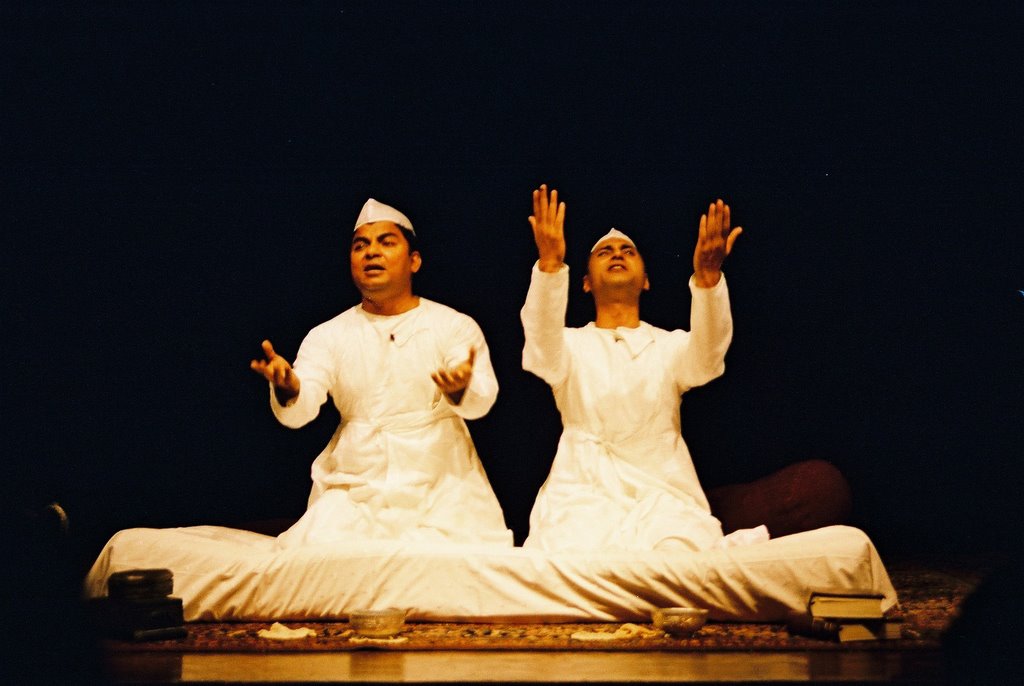
Mahmood Farooqui (right) and Danish Husain perform the dastangoi


Telling Tales


Mahmood Farooqui gives Pragya Tewari a lesson in the creation and performance of the dastangoi, a form that resurrects the medieval art of telling fantastic stories


Mahmood Farooqui


How did the idea of the performance come about?

I was familiar with dastans but had never really studied them. My uncle, S.R. Farooqui, has written a comprehensive book on the subject which I happened to read, and found myself hooked to the humour, the drama and the economy of expression. A fellowship with the organisation Sarai followed and I began toying with the idea of making a film on dastans. Last year in May, I got an offer from the India International Centre (IIC) in Delhi to present lecture demonstrations on dastans and realised the best way to present them would be through a performance.

Were you sceptical about audience response to the show?

I was apprehensive that a non-Urdu speaking audience would not follow the dastans. Besides, it seemed like a challenge to be able to hold the attention of the audience without much dramatic action on stage. However, their reaction surpassed my expectations and I found myself performing to a near ideal audience at IIC. That made me realise this could stand as a show. Subsequently I began to receive similar responses from non-Urdu speaking audiences and even foreigners completely unfamiliar with the language. If you are making them laugh, you most certainly have them hooked. That made me realise that beyond the content, the style of recitation and the form itself were attractive and I found the courage to devise ways to convert even a less than ideal audience to an ideal one.

The acting/recitation skills you have used are closer to modern acting styles; is this what makes it more accessible to the audience?

Yes. We are two storytellers on stage, though there used to be just one originally. Our delivery is more modern, but I have tried to imbibe the essence of the original art. Even though I haven't heard Mir Baqar myself, I had help from my uncle S.R. Farooqi who has researched dastangoi. In Dehradun we performed in front of Habib Tanvir who gave us some valuable inputs. He has been working with traditional forms for years. I have been trying to strike the right balance between dramatisation and recitation. Our form has been constantly evolving and will continue to do so.

Do you see dastangoi as a related but separate performance art form or is it essentially theatre for you?

For me, this is most definitely theatre. I am using my body and voice to reach out to a live audience. We need to broaden our definition of theatre. The modern definition built around the proscenium and western sensibilities does not pertain to our context. It leaves a lot of traditional Indian forms out. For instance, it is common practice for Ghazal singers to address the audience directly during their performances asking them to pay heed to a particular couplet. That, according to me, is theatrical.

Are your performances a one-off attempt to acquaint people with a lost legacy or do you want to revive this art?

I am interested in reviving dastangoi. But I am aware that a stand-alone performance is not enough. A revival would only be underway if more people started performing these stories. Not necessarily in the form I am using, but others could dramatise the dastans or add music to the recitations. The stories can also be contemporised or given a political nuance. For instance, Amar Aiyyar, the hero of our story, could land in Tilism-e-America or Iraq. Even if these performances can generate interest enough for people to buy and read the stories, a sort of revival could be effected. I consider myself contributing more significantly to this revival when I find myself improvising the stories and adding to them in my performances.

Traditionally, dastangoi has been entertainment for the masses. Do you think they would be as receptive to your performances as the theatre-going audiences have been?

These stories have influenced the earliest writers of Hindi cinema. The masses are therefore familiar with the plots and characters of these dastans. Besides the people of this country are still semi-illiterate which means there is a lot of scope for the oral tradition of stories to flourish.

Why is this revival important?

These stories were written when self-hatred had not set into our society. They are devoid of colonial influence and marked by unfettered imagination. Fantasies are political because they open up an alternative worlds and possibilities without hammering any point home. These stories are a hallmark of Indian literature. They provide with valuable insights into the history of our languages and writing. It is important for us to discover such independent realms where language can be refashioned and reclaimed from pundits and maulvis.

Do you see these stories as unadulterated, non-politicised lessons in history as well?

They present a joyous, hedonistic and secular picture of a society with no taboos. There are humorous descriptions of god and saints and references to ‘Islami Sharaab’. These stories were recited on the steps of Jama Masjid, among other places, without any censorship. They reek of a republican spirit and demonstrate the possibilities of critique inherent in our tradition.


The next Dastangoi performance will be held at Prithvi Theatre on July 1 and 2, at 9 pm


Copyright 2005 BCCL. All rights reserved.

The DNA Trip


Urdu tales take centre-stage
Sandhya Menon
Tuesday, June 27, 2006 17:47 IST


Two men clad in pristine white, surma-eyed, regale a slightly unsure audience with stories of warfare, trickery and sorcery. That’s ‘dastangoi’ for you – a lost form of storytelling in Urdu. Bringing it back and to Prithvi this weekend are Mahmood Farooqui and Danish Hussain.

“Dastangos were those who told ‘dastans’ (stories). Recounting tales of Amir Hamza, the Prophet Mohammed’s uncle, they told narratives of his battles with infidels, sorcerers and other pretenders to divinity,” says Farooqui.

This performance consists of portions of the best-known ‘daftar’ or chapter, of the 46 volume Dastan-e-Amir Hamza, the Tilism Hoshruba or ‘enchantment that steals away the senses’.

“Because this form died out about 120 years ago, we had nothing to draw from in terms of presentation. We’re still evolving the form to suit performance values,” says Farooqui, a self-trained actor from Delhi.

One would think that as Urdu is usually considered a language of erudition and poetry, following an entire story in the language wouldn’t be everyone’s cup of tea. “It is only in the beginning of the performance that people are a little hesitant,” says Hussain.

“They usually pick up a thread soon and they’re just sucked in by the magic of it all.”

Another reason these stories are easy to follow is the fact that the Dastan-e-Amir Hamza, though originally composed in Persian, was translated to Urdu at a time when the demarcation between Hindi and Urdu wasn’t so deep, when most people in northern parts of India spoke a mixture of both languages, says Farooqui. “But more than anything else, everyone loves a good story,” he adds.